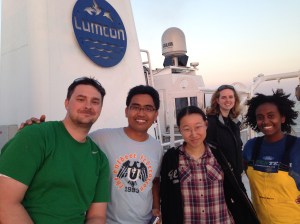
The Hamdan Lab celebrates World Oceans Day with the Waitt Institute, Smithsonian, and Wikipedia

wikiworldoceans wikiworldoceans2

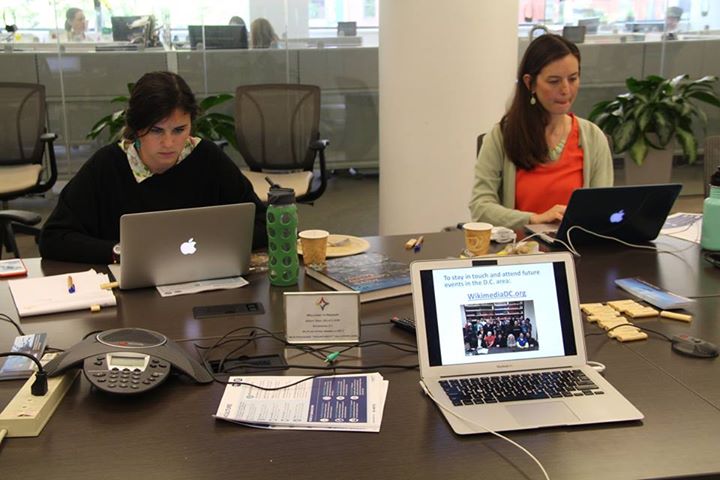
Hard at work on updating Wikipedia ocean pages (photo courtesy of Waitt Institute)

On June 8th, Hamdan Lab postdoc Jen Salerno, joined up with other ocean experts to participate in an Edit-A-Thon to update ocean-related Wikipedia pages in honor of World Oceans Day. The event was sponsored by the Waitt Institute, Smithsonian Ocean Portal, and the Wikimedia Foundation. Wikipedia is often a starting point for students and professionals alike when beginning to research a subject. Participants in the Edit-A-Thon sought to fill in information gaps and missing links related to important ocean topics such as ocean zoning, environmental DNA, bacterioplankton, ocean acidification, coral reefs, aquaculture, and overfishing. They created new Wikipedia pages for these topics or updated existing ones with the latest peer-reviewed science, ensuring that those seeking information about the ocean can be directed to the primary literature and a diversity of other reliable sources.

Experts from Wikimedia DC were there to explain the ins and outs of Wikipedia including how to properly edit a page to make sure the edits were verifiable and free from conflicts of interest. Soon after, participants felt comfortable enough with the process to begin editing pages of interest on their own. Dr. Salerno added a policy-related entry to the aquaculture page and upon seeing the paltry amount of information on the bacterioplankton page, decided to take a crack at that too. After all, we’re a microbiology lab and we all have bacterioplankton to thank for the oxygen that we breathe! The page is a work in progress that she hopes to continue with as well as inspire others in her field to contribute to. In fact, there might just be a mini Wikipedia Edit-A-Thon at the next lab meeting…

A special thanks to the Waitt Institute, Smithsonian Ocean Portal, and the Wikimedia Foundation for hosting the event. If you would like to learn more about the Edit-A-Thon, please read Waitt Institute Executive Director, Dr. Ayana Johnson’s excellent article on the National Geographic blog. Editing Wikipedia is easy and fun! Try it!

SCHEMA Project Featured on UNOLS Site

Our multidisciplinary shipwreck study (SCHEMA) conducted on board the R/V Pelican and supported by the Bureau of Ocean Energy Management, the Bureau of Safety and Environmental Enforcement and the Naval Research Laboratory Platform support program is being featured on the University-National Oceanographic Laboratory System (UNOLS) main page.  Ever wonder how oceanographic research gets done? What ships are available for research purposes? What kind of studies happen in the coastal, estuarine and marine environment? Learn about this and more at http://www.unols.org. UNOLS is an organization of 62 academic institutions and National Laboratories involved in oceanographic research and joined for the purpose of coordinating oceanographic ships’ schedules and research facilities.  George Mason University became a non-operator member of UNOLS in October of 2014.
Learn more about our project, and other exciting studies here!

Dr. Allen Reed supervising deck operations on board the R/V Pelican.

Calling all CERF members: Election Time

I am excited and honored to be running for President-elect (2015-2017) of the Coastal and Estuarine Research Federation.  While CERF was not the first professional society that I joined (it was ASM – I’m a microbiologist, what can I say), it has long been my home society.  It is an organization composed of seven regional affiliate societies, and dedicated members spanning all disciplines of scientific research and management of coastal and estuarine environments.

Please visit http://www.erf.org to learn more about CERF, our exciting conference in November, 2015 (#CERF2015) and about all of the candidates for the CERF Governing Board.

And for CERF members in good standing, don’t forget to cast your VOTE before July 10!

cerf


Earth Day Lightning Talks at GMU

On Earth Day 2015, the Center for Ocean-Land-Atmosphere Studies (COLA), the College of Science, and the Office of Sustainability at GMU organized a series of 3-minute presentations, on various topics in earth and climate science.  Students, staff, and faculty took the challenge to “enlighten us, but make it quick.”  Leila Hamdan prepared a 3 minute primer on our Gulf of Mexico Shipwreck study.

Leila’s talk, along with several other exciting talks from GMU scientists can be found here:

GOM-SCHEMA Cruise Log 5 – 05/01/15 (Hernando Bacosa)

IMG_0496

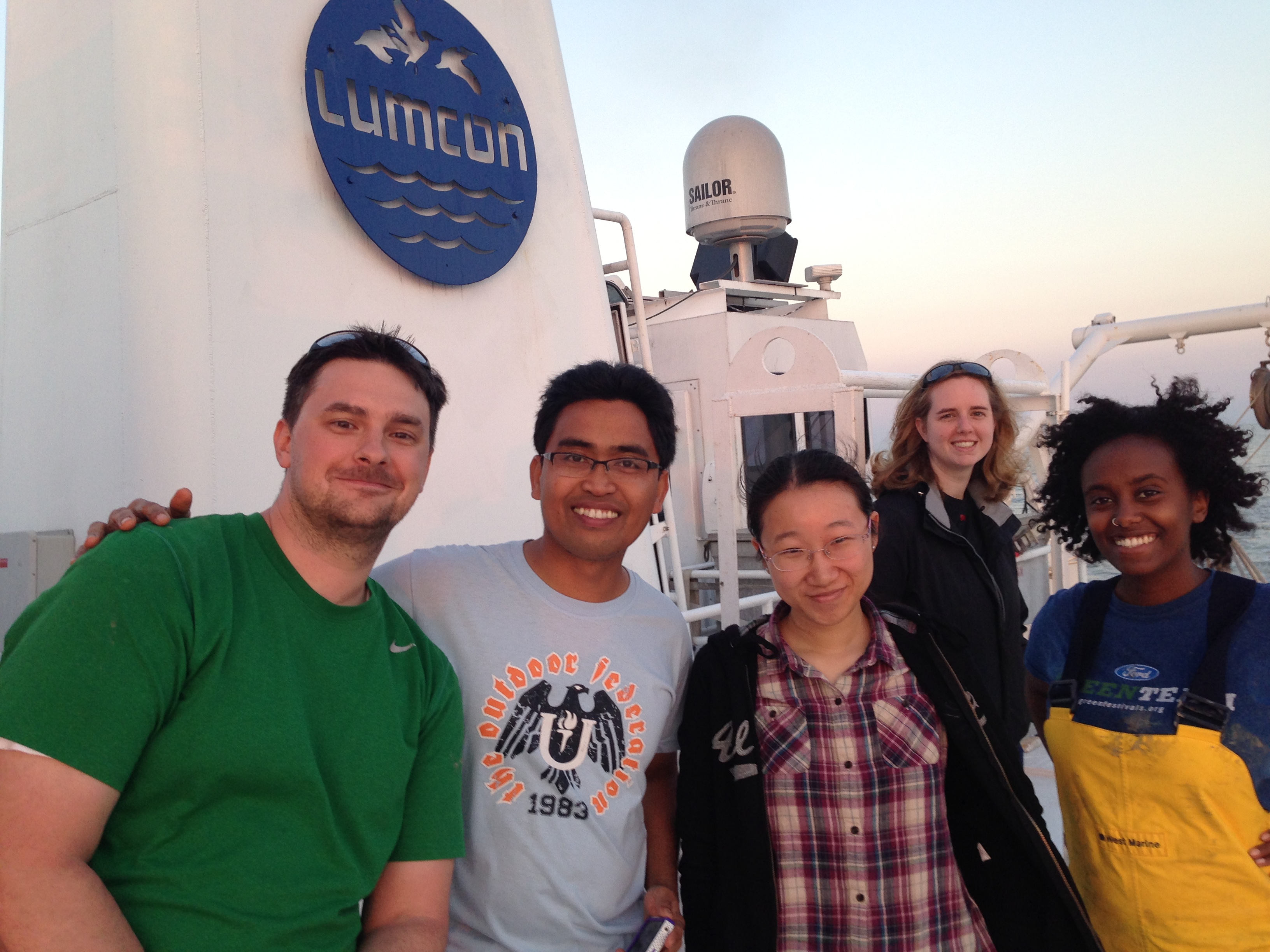
This is my third cruise aboard the R/V Pelican since I joined UTMSI in April 2013. My research is funded by the Gulf of Mexico Research Initiative (GOMRI) through the consortium on the Dispersion Research on Oil: Physics and Plankton Studies (DROPPS) and focuses on understanding the fate of oil following the Deepwater Horizon spill in 2010. My goal in joining this cruise is to obtain surface water and seafloor sediment. Back in the laboratory, I will incubate surface water with crude oil and 13C-labeled hexadecane as a representative aliphatic hydrocarbon, or 13C-labeled phenanthrene as a representative of the more toxic aromatic hydrocarbons. I use DNA- Stable Isotope Probing (SIP), a molecular technique that can identify what bacterial groups assimilated the amended substrates.  I will do the same procedure for the sediment samples but the incubation period will be longer and the temperature will be around 5℃.

It was my first time being sea sick, mostly due to the bad weather the first two days of the cruise. But that is how nature works and science can be fun despite rough seas. We have an amazing science team aboard from whom I have learned many new techniques, such as isolation of anaerobic bacteria, particle analysis, sample preservation, and handling sediment cores. While waiting for the sediment core and the CTD cast, it was great to learn about each other’s research projects and plan for future collaboration. 1

Quick mention, but the food has been great all trip! My favorite had to be when the chef made delicious Cajun food when served with rice.  I hope to be back soon!

To end our research interviews, I will be introducing Ellen Roosen from WHOI.  She has been maintaining and working with the camera system attached to the multi-corer that collected the sediment samples.  The camera system is called MISO and belongs to Dr. Dan Fornari.  It was brought aboard due to Dr. Hamdan’s need to see the ocean floor before multi-coring; need to get sediment, not parts of the shipwreck.

The system has been working great all week!  Its best point is the fact that we’re getting real time imaging of the sea floor when it was down there on the multi-corer.  Images have been clear enough to see tubeworm boroughs, fish, and detailed topography of the floor. The system was designed to aid scientists conducting deep-sea research.  Dr. Fornari would love to get the word out about it so its use can spread and benefit more research projects.
GOM-SCHEMA Cruise Log 4 – 04/30/15 (Chrissy Figan)

DCIM999GOPRO


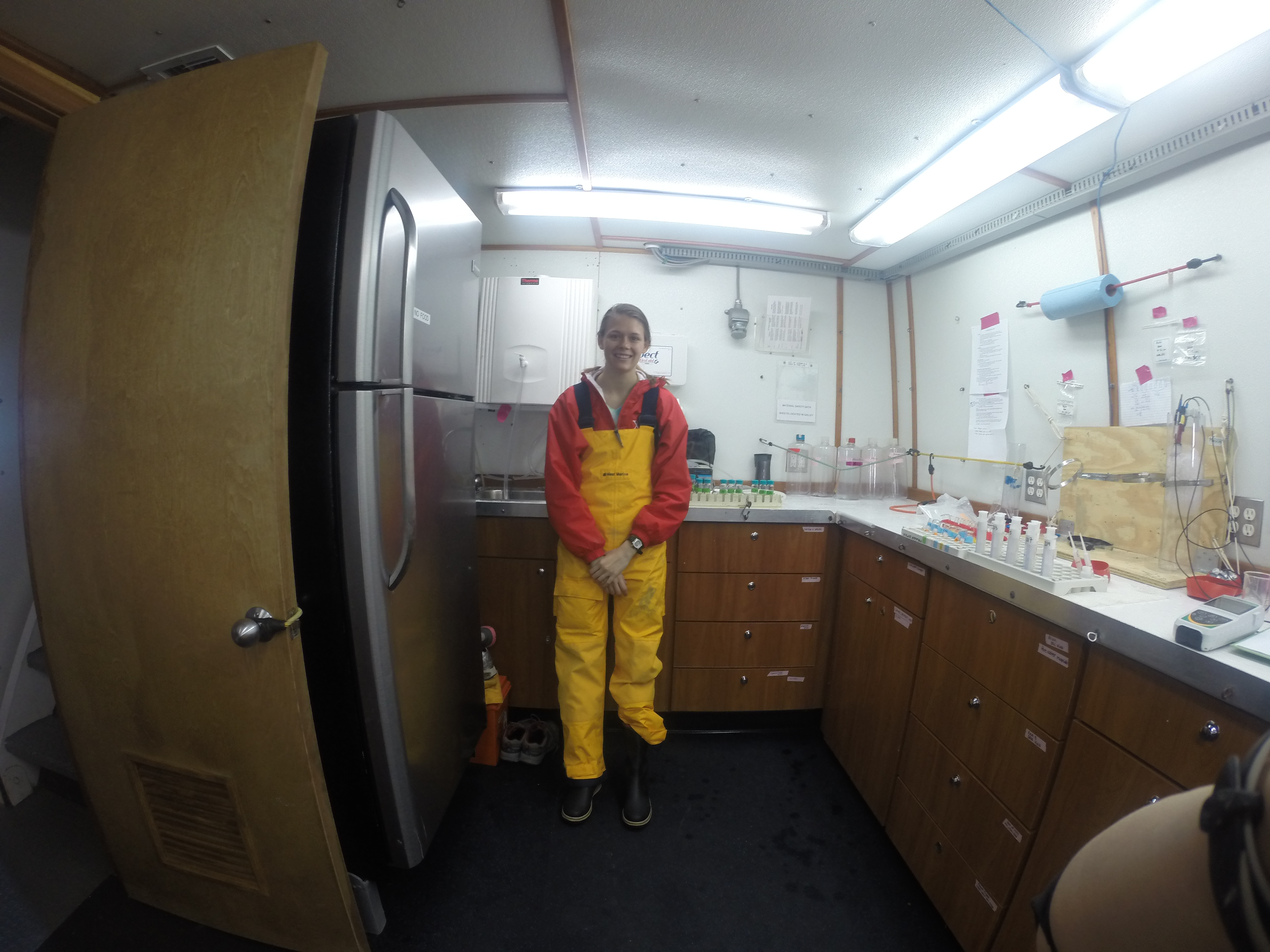
Our morning began with sunny skies and dolphins swimming alongside the R/V Pelican. With only two full workdays left, the science party had a very busy day in store. To begin, we cast the multi-coring device twice, both times with unsuccessful results. However, we continued to make adjustments and ran a trigger test on deck. While waiting on sediment samples, we cast our last CTD. I have very much enjoyed harvesting water samples, so the last time came with mixed emotions.

After lunch, the day continued in an upward direction as we collected our first four beautiful, full mud cores. After extruding each core, two were packaged for science departments on land, one was sliced into packets by depth, and one was used to extract pore water. We will analyze our mud samples at Dr. Leila Hamdan’s lab at GMU for properties like dissolved inorganic carbon, polycyclic aromatic hydrocarbon (PAH), etc.

Personally, it’s been an enlightening experience learning from scientists from many departments and contributing to their projects. A researcher from the Naval Research Lab at the Stenis Space Center, Dr. Allen Reed, is collecting both sediment and water samples in order to characterize sediment behavior and acoustic properties. Onboard the R/V Pelican, Allen brought CELIS, a particle size analyzer in which he inserts seawater and sediment samples from the sea floor. He will use this data to help his project in understanding sedimentation. I met Allen on the last research cruise in July, and I was ecstatic to work with him again. All scientists here have been a pleasure to work with. Once again, it’s been a remarkable experience doing science at sea!

GOM-SCHEMA Cruise Log 3 – 04/29/15 (Emily Petersen)

IMG_0473

With a happy change in weather that made for calmer seas (and in turn calmer stomachs), all those aboard returned to their work with jubilation.

Depending on your perspective, the scientific crew was up late Tuesday night or very early Wednesday morning (11:30 PM – 4:30 AM) for a successful CTD water column collection at the U166 shipwreck.  Now, having had some practice with their experiments in the laboratory spaces aboard the R/V Pelican, the scientific crew was working well together, instinctually reacting to their fellow researchers responses….basically, what we like to refer to as the “dance.”  This is when verbal communication is limited and scientific procedure becomes second nature.

Up at 6 AM, only a few hours later, the crew lead a series of multi-corer deployments for sediment collection at the Viosca Knoll shipwreck.  Multiple attempts were unsuccessful, however, even after several procedural and mechanical adjustments.  The CTD collection went smoothly though, continuing Dr. Lisa Fitzgerald and Dr. Preston Fulmer’s experiments of growing microbial life from seawater.

Dr. Peter Wu, our resident physicist, shared the group’s frustration with the lack of sediment collected.  However, he remains positive because he knows that in research many experiments fail, but that is never any reason to stop searching for a solution.

This afternoon we made our way to the third site of the day, the Anona shipwreck. CTD water samples were collected again and kept at least part of the scientific crew up again, “dancing” late into the night.