Post Doctoral Research Scientist Position Now Open!

Apply Here! The University of Southern Mississippi is currently accepting applications for the position of Post Doctoral Research Scientist in the Hamdan Lab.

The Hamdan Lab in the School of Ocean Science and Engineering at the University of Southern Mississippi seeks a postdoctoral researcher to support microbiome studies of benthic ecosystems, primarily within the Gulf of Mexico. Individuals with experience with microbiology and biogeochemistry, with specific knowledge and expertise in molecular ecology, are encouraged to apply. Interested candidates should be motivated to take a project vision and shape it with scientific expertise, and work with a team to support discovery and learning.

Islands Under Sea: Shipwreck Microbiomes of Keathley Canyon

In August 2023, the Hamdan Lab embarked on an expedition to explore shipwrecks in the Keathley Canyon lease area. The primary goals were to investigate previously identified sonar targets, determine if they were shipwrecks, and take sediment samples to investigate the microbial communities surrounding the shipwrecks. Five sonar targets were investigated and determined not to be shipwrecks. However, the nearby Monterrey Shipwrecks, a cluster of 3 historic shipwrecks, provided the opportunity to take sediment samples and investigate the microbial community of these uniquely positioned shipwrecks. Please see this link for the full NOAA Ocean Exploration website coverage of the expedition or click the project title under “Research Interests” in the Navigation bar and read the feature from the NOAA website to learn more about the expedition. Click the links throughout the feature to learn more about microbes and shipwrecks! Interested in learning more about the interdisciplinary field of shipwreck ecology? See this recent paper in BioScience that Dr. Hamdan contributed to.

Double Publication Alert! Two papers from the Hamdan Lab published this week

The Hamdan Lab had two papers published this week, both led by Dr. Rachel Mugge. Dr. Mugge is a recent PhD graduate of the Hamdan Lab and the papers stem from her dissertation research . The first, “Proximity to built structures on the seabed promotes biofilm development and diversity” by Rachel Mugge, Chet Rakocinski, Max Woolsey, and Leila Hamdan, was published in Biofouling . This study involved short-term seafloor experiments containing steel surfaces placed near six structures, including historic shipwrecks and modern decommissioned energy platforms. Biofilms were analyzed for changes in phylogenetic composition, richness, and diversity relative to proximity to the structures. The biofilm core microbiome was primarily composed of iron-oxidizing Mariprofundus, sulfur-oxidizing Sulfurimonas, and biofilm-forming Rhodobacteraceae. Alpha diversity and richness significantly declined as a function of distance from structures. This study explores how built structures influence marine biofilms and contributes knowledge on how anthropogenic activity impacts microbiomes on the seabed. See more here.

The second, “Substrate Specificity of Biofilms Proximate to Historic Shipwrecks” by Rachel Mugge, Rachel Moseley, and Leila Hamdan, was published in Microorganisms. The goal of this study was to understand the substrate- and site-specific impacts of built structures on short-term biofilm composition and functional potential. Seafloor experiments were conducted wherein steel and wood surfaces were deployed for four months at distances extending up to 115 m away from three historic (>50 years old) shipwrecks in the Gulf of Mexico. A bioinformatics analysis revealed that the taxonomic composition was significantly different between substrates and sites, with substrate being the primary determining factor. Regardless of site, the steel biofilms had a higher abundance of genes related to biofilm formation, and sulfur, iron, and nitrogen cycling, while the wood biofilms showed a higher abundance of manganese cycling and methanol oxidation genes. This study demonstrates how substrate composition shapes biofilm microbiomes and suggests that marine biofilms may contribute to nutrient cycling at depth. See more here.

Thanks for following our research!

RDM

Dr. Leila Hamdan Selected for National Academies Panel to Guide Ocean Science into the Next Decade

“Dr. Leila Hamdan has been selected to contribute her expertise to the National Academies’ 2025-2035 Decadal Survey of Ocean Sciences. This survey will advise the National Science Foundation’s Division of Ocean Sciences’ strategy towards investments in research, oceanographic infrastructure and development of the future ocean science workforce. The 21-member expert committee includes ocean scientists from across the nation working in disciplines spanning biological, chemical, physical and geological oceanography, policy, social science and engineering. “I am honored to be selected for this committee and to have the opportunity to work with an incredible group of professionals as we identify research needs and priorities for the future,” said Hamdan. Dr. Kelly Lucas, USM Vice President for Research, noted the significance of Hamdan serving as the only member of the committee from an institution located in the Gulf of Mexico region. “This is an invaluable opportunity to communicate on the complex science challenges of the Gulf region, and make sure the needs for scientific discovery and infrastructure of the Gulf are heard,” said Lucas. The committee’s work will span approximately 18 months, and through a careful framework, will develop a list of questions that have potential to transform what we know about the ocean, and the critical role the ocean plays for all life on earth. “The work we do together will influence the pace of scientific discovery, and how those discoveries shape lives, technology and careers into the future”, said Hamdan.”

– Excerpt from Van Arnold’s article found here

Find out more about the 2025-2035 Decadal Survey of Ocean Sciences here

Positions Open for TWO Postdoctoral Research Scientists

Please apply on the USM career site:https://usm.csod.com/ats/careersite/JobDetails.aspx?id=3151&site=1

These positions are full time jobs in the Hamdan Lab at the University of Southern Mississippi’s Gulf Coast Research Laboratory in Ocean Springs, MS.

Job Summary 
The Hamdan Lab at the University of Southern Mississippi seeks a Postdoctoral Research Scientist to support a 3-year project funded by NOAA’s Ocean Exploration Cooperative Institute. This project will contribute to multidisciplinary investigation of benthic microbial communities in the Gulf of Mexico. Project work will contribute to characterizing the seafloor in areas potentially inured by the Deepwater Horizon spill. The study investigates sediment microbiomes using culture-independent techniques to investigate community composition, alpha and beta diversity and metabolic potential. These data will contribute to monitoring ecosystem state and trajectory in sediment. The position will oversee the day-to-day management of this research project, in consultation with the principal investigator, and lead research efforts in collaboration with external scientists coordinating analysis of geochemical and macrofaunal data sets. Data management, laboratory analyses, data synthesis, publication of results in peer-reviewed journals and management of a project budget will be carried out as part of this position. Individuals with experience with microbiology and biogeochemistry, with specific knowledge and molecular biological techniques (DNA extraction, amplification, sequencing) are encouraged to apply. Experience and proficiency in bioinformatics and statistical analysis are desired. All applications must be submitted through the USM career site. Please contact Leila Hamdan (Leila.hamdan@usm.edu) with specific questions.

 Primary Duties and Responsibilities  

  1.  Develop experimental design and analyses to study potentially oil-impacted sediment microbiomes and metagenomes to characterize bacterial, archaeal, and fungal communities.
  2. Develop expertise in deep-sea sediment microbial communities and contribute new knowledge and ideas to this area of research.
  3. Develop and apply bioinformatics tools and approaches to identify communities, relevant taxa and associations. Learn and apply machine learning tools to datasets generated during the study.
  4. Participate in planning and executing field work on board USM’s Research Vessel Point Sur, and other oceanographic research vessels during 2 -4 week field campaigns. 
  5. Contribute to written and oral communication, including peer-reviewed manuscripts, blog posts, outreach through social media, and the public.
  6. Archives data and maintains databases, and contributes to budget management.
  7. Participate in student mentoring.
  8. Perform other duties as assigned.

Minimum Qualifications A Ph.D. from an accredited college or university in coastal or marine sciences, microbiology, geomicrobiology, biogeochemistry or similar field.  

Knowledge, Skills & Abilities 

  • Proficiency in laboratory practice, experimental design, laboratory safety procedures
  • A high level of computer literacy
  • Ability to read and interpret safety rules, operating and maintenance instructions, and procedure manuals
  • Excellent written and oral communication skills and ability and interest in communicating with diverse groups
  • Ability to write reports, correspondence, and peer-reviewed manuscripts 
  • Ability and interest in contributing to outreach activities.
  • Ability to contribute to a positive work environment built on trust and transparency that values different perspectives and backgrounds

Preferred Qualifications  Experience with analytical laboratory methods, experience with molecular biology methods, proficiency in bioinformatics and statistical analysis.


About The University of Southern Mississippi
The University of Southern Mississippi (USM) is a comprehensive public research institution delivering transformative programs on campuses in Hattiesburg and Long Beach, at teaching and research sites across the Mississippi Gulf Coast, as well as online. Founded in 1910, USM is one of only 131 universities in the nation to earn the Carnegie Classification of Institutions of Higher Education’s “R1: Doctoral Universities – Very high research activity” designation, and its robust research enterprise includes experts in ocean science and engineering, polymer science and engineering, and large event venue safety and security, among others.  USM is also one of only 37 institutions in the nation accredited in theatre, art and design, dance and music. As an economic driver, USM generates an annual economic impact of more than $600 million across the state. USM welcomes a diverse student body of more than 14,000, representing 71 countries, all 50 states, and every county in Mississippi. USM students have collected four Truman Scholarships and 37 National Science Foundation Graduate Research Fellowships, while also leading Mississippi with 27 Goldwater Scholarships, an honor that recognizes the next generation of great research scientists. Home to the Golden Eagles, USM competes in 17 Division I sports sponsored by the National Collegiate Athletic Association (NCAA). For more information, visit www.usm.edu.

As an Affirmative Action/Equal Employment Opportunity employer/Americans with Disabilities Act institution, The University of Southern Mississippi encourages minorities, women, veterans and persons with disabilities to apply.
Seeking a Postdoctoral Researcher in Marine Molecular Ecology!

Please see this link for additional information and to apply:https://usm.csod.com/ats/careersite/JobDetails.aspx?id=3151&site=1

This is a full time job in the Hamdan Lab at the University of Southern Mississippi’s Gulf Coast Research Laboratory in Ocean Springs, MS.

Job Summary 
The Hamdan Lab at the University of Southern Mississippi seeks a Postdoctoral Research Scientist to support a 3-year project funded by NOAA’s Ocean Exploration Cooperative Institute. This project will contribute to multidisciplinary investigation of benthic microbial communities in the Gulf of Mexico. Project work will contribute to characterizing the seafloor in areas potentially inured by the Deepwater Horizon spill. The study investigates sediment microbiomes using culture-independent techniques to investigate community composition, alpha and beta diversity and metabolic potential. These data will contribute to monitoring ecosystem state and trajectory in sediment. The position will oversee the day-to-day management of this research project, in consultation with the principal investigator, and lead research efforts in collaboration with external scientists coordinating analysis of geochemical and macrofaunal data sets. Data management, laboratory analyses, data synthesis, publication of results in peer-reviewed journals and management of a project budget will be carried out as part of this position. Individuals with experience with microbiology and biogeochemistry, with specific knowledge and molecular biological techniques (DNA extraction, amplification, sequencing) are encouraged to apply. Experience and proficiency in bioinformatics and statistical analysis are desired. All applications must be submitted through the USM career site. Please contact Leila Hamdan (Leila.hamdan@usm.edu) with specific questions.

 Primary Duties and Responsibilities  

  1.  Develop experimental design and analyses to study potentially oil-impacted sediment microbiomes and metagenomes to characterize bacterial, archaeal, and fungal communities.
  2. Develop expertise in deep-sea sediment microbial communities and contribute new knowledge and ideas to this area of research.
  3. Develop and apply bioinformatics tools and approaches to identify communities, relevant taxa and associations. Learn and apply machine learning tools to datasets generated during the study.
  4. Participate in planning and executing field work on board USM’s Research Vessel Point Sur, and other oceanographic research vessels during 2 -4 week field campaigns. 
  5. Contribute to written and oral communication, including peer-reviewed manuscripts, blog posts, outreach through social media, and the public.
  6. Archives data and maintains databases, and contributes to budget management.
  7. Participate in student mentoring.
  8. Perform other duties as assigned.

Minimum Qualifications A Ph.D. from an accredited college or university in coastal or marine sciences, microbiology, geomicrobiology, biogeochemistry or similar field.  

Knowledge, Skills & Abilities 

  • Proficiency in laboratory practice, experimental design, laboratory safety procedures
  • A high level of computer literacy
  • Ability to read and interpret safety rules, operating and maintenance instructions, and procedure manuals
  • Excellent written and oral communication skills and ability and interest in communicating with diverse groups
  • Ability to write reports, correspondence, and peer-reviewed manuscripts 
  • Ability and interest in contributing to outreach activities.
  • Ability to contribute to a positive work environment built on trust and transparency that values different perspectives and backgrounds

Preferred Qualifications  Experience with analytical laboratory methods, experience with molecular biology methods, proficiency in bioinformatics and statistical analysis.


About The University of Southern Mississippi
The University of Southern Mississippi (USM) is a comprehensive public research institution delivering transformative programs on campuses in Hattiesburg and Long Beach, at teaching and research sites across the Mississippi Gulf Coast, as well as online. Founded in 1910, USM is one of only 131 universities in the nation to earn the Carnegie Classification of Institutions of Higher Education’s “R1: Doctoral Universities – Very high research activity” designation, and its robust research enterprise includes experts in ocean science and engineering, polymer science and engineering, and large event venue safety and security, among others.  USM is also one of only 37 institutions in the nation accredited in theatre, art and design, dance and music. As an economic driver, USM generates an annual economic impact of more than $600 million across the state. USM welcomes a diverse student body of more than 14,000, representing 71 countries, all 50 states, and every county in Mississippi. USM students have collected four Truman Scholarships and 37 National Science Foundation Graduate Research Fellowships, while also leading Mississippi with 27 Goldwater Scholarships, an honor that recognizes the next generation of great research scientists. Home to the Golden Eagles, USM competes in 17 Division I sports sponsored by the National Collegiate Athletic Association (NCAA). For more information, visit www.usm.edu.

As an Affirmative Action/Equal Employment Opportunity employer/Americans with Disabilities Act institution, The University of Southern Mississippi encourages minorities, women, veterans and persons with disabilities to apply.
Congratulations Dr. Mugge!

Rachel Mugge successfully defended her dissertation! Her dissertation titled “The expanding marine built environment and biofilm formation processes” investigated biofilm samples from metal and wood substrates from six sites in the Gulf of Mexico, including four historic shipwreck sites, and a laboratory experiment. Congratulations Dr. Mugge! Stay tuned to see the papers published from her work.

-RDM

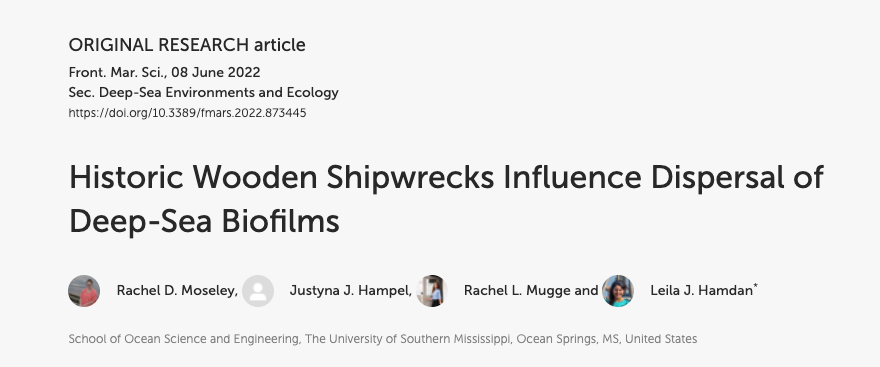
New Publication Alert! Historic Wooden Shipwrecks Influence Dispersal of Deep-Sea Biofilms

The research article “Historic Wooden Shipwrecks Influence Dispersal of Deep-Sea Biofilms” by Rachel Moseley, Dr. Justyna Hampel, Rachel Mugge, and Dr. Leila Hamdan was published in Frontiers in Marine Science. This research was done as part of the Microbial Stowaways project.

Wood arrives on the seabed from natural and anthropogenic sources (e.g., wood falls and wooden shipwrecks, respectively) and creates seafloor habitats for macro-, meio- and microbiota. The way these habitats shape microbial communities and their biogeographic patterns in the deep sea requires study. The objective of this work was to investigate how historic wooden-hulled shipwrecks impact the dispersal of wood-colonizing microbial biofilms. The study addressed how proximity to wooden shipwrecks shapes diversity, richness, and community composition in the surrounding environment. Study sites included two historic shipwrecks in the northern Gulf of Mexico identified as wooden-hulled sailing vessels dating to the late 19th century. Two experimental microbial recruitment arrays containing pine and oak samples were deployed by remotely operated vehicle proximate (0–200 m) to each shipwreck and used to establish new wooden habitat features to be colonized by biofilms. The experiments remained in place for approximately 4 months, were subsequently recovered, and biofilms were analyzed using 16S rRNA gene amplification and sequencing for bacteria and archaea and ITS2 region amplification and sequencing for fungi to determine alpha diversity metrics and community composition. The work examined the influence of wood type, proximity to shipwrecks, and environmental context on the biofilms formed on the surfaces. Wood type was the most significant feature shaping bacterial composition, but not archaeal or fungal composition. Proximity to shipwrecks was also a significant influence on bacterial and archaeal composition and alpha diversity, but not on fungal communities. In all 3 domains, a peak in alpha diversity and richness was observed on pine and oak samples placed ~125 m from the shipwrecks. This peak may be evidence of an ecotone, or convergence zone, between the shipwreck influenced seabed and the surrounding seafloor. This study provides evidence that historic wooden shipwrecks influence microbial biofilm dispersal in the deep sea.

For the full article: https://www.frontiersin.org/articles/10.3389/fmars.2022.873445/full

This article also received media attention including this article from Newsweek: https://www.newsweek.com/under-sea-shipwrecks-expand-microbial-diversity-new-study-shows-1714833

Thanks for following our research!!

RDM

New Publication Alert! “Microbiomes respond predictably to built habitats on the seafloor” published in Molecular Ecology

A new paper from the Hamdan Lab was published in Molecular Ecology. “Microbiomes respond predictably to built habitats on the seafloor” was led by Dr. Justyna Hampel with Rachel Moseley and Dr. Leila Hamdan. The study addresses the impact of shipwrecks on surrounding seafloor microbiomes by using 762 deep-sea sediment samples from around nine shipwrecks in the Gulf of Mexico.

The seafloor contains complex ecosystems where habitat heterogeneity influences biodiversity. Natural biological and geological features including vents, seeps and reefs create habitats that select for distinct populations of micro- and macrofauna. While largely studied for macrobiological diversity, built habitats may also select distinct microbiomes. Built habitat density on the seafloor is increasing with ocean sprawl expanding in the continental shelf and slope, potentially having widespread effects on benthic communities. This study addresses one type of built habitat, shipwrecks, on microbiomes in surrounding sediment. Using deep-sea sediment samples (762 total) from the Gulf of Mexico, we report elevated diversity and a predictable core microbiome around nine shipwrecks. We show the sphere of influence of built habitats extends up to 300 m onto the seafloor. Supervised learning made predictions of sample proximity to structures based on frequency of taxa. Strongest predictions occurred in sediments nearest and furthest from sites for archaea and mid-transect for bacteria. The response of archaea to built habitats was consistent across sites, while bacteria showed greater between site variability. The archaeal core shipwreck microbiome was enriched in taxa (e.g., Bathyarchaeia, Lokiarchaeia, Thermoplasmata) not present in the surrounding seafloor. Shipwrecks shaped microbiomes in expected ways, providing insight on how built habitats impact microbiome biodiversity in the Anthropocene.

Check out the full paper to learn more!

-RDM

Smithsonian Magazine Quotes Dr. Hamdan

Smithsonian Magazine recently released an article titled “How Shipwrecks Shape the Seafloor”. The article interviews several shipwreck researchers, including Dr. Leila Hamdan, to discuss how sunken vessels influence marine ecosystems. Shipwreck ecosystems are vitally important to understand and our lab at The University of Southern Mississippi is continuing to make discoveries in the field.

As Dr. Hamdan said at the end of the article, ‘“All you need to do is, wherever you are right now, look out your window,” Hamdan said. Consider how humans have shaped the terrestrial world and the distribution of organisms within it. We’re doing that with the seafloor as well, we just don’t see it,” she said. “We now know that human debris is changing the most fundamental units of life on the seabed, just by being there.”’

Read the full article here: https://www.smithsonianmag.com/blogs/national-museum-of-natural-history/2022/05/12/how-shipwrecks-shape-the-seafloor/

Stay tuned to our website to continue learning about our research. We have two new publications coming soon!

-RDM